Custom Engagements
No software engineering project is like another. And when they run into trouble, no one method is going to fix it all. Not one tool. Not one process. Nor one philosophy, either.
It takes a deep understanding of the dynamics in the organization, the technical challenges, the skills available, the inertia of the legacy and its complexity and management commitment. And after factoring all that, figuring out a strategy that has a decent chance of success.
 i
i
. . .
Figure 1.
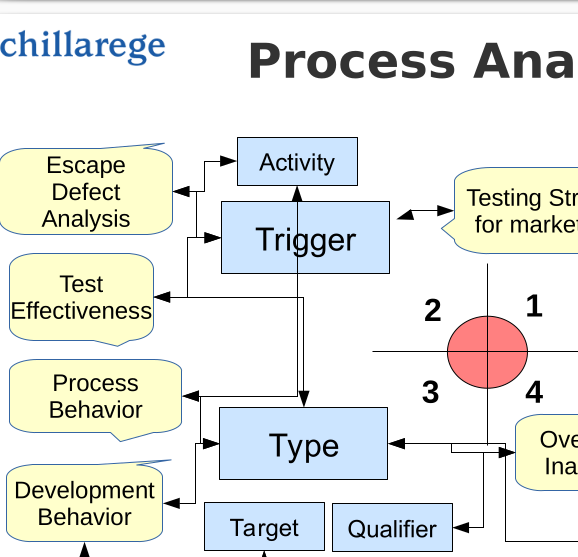
How ODC exactly plays in this challenge is not a short discussion. But, I want to illustrate just one aspect of what ODC data can do using Figure 1. The case studies (that are longer to read) can help more.
The blue boxes are core ODC categories. The yellow callouts are analysis that leverage the data. Note that different analyses can use the same data. So, what is collected once, feeds a family of analyses. Add to that the time dimension, sampling methods and versions and the possibilities explode. `
The better our diagnostic instruments and the greater the experience behind the knife, the greater the chances of success.
This is what we bring to you - The best in the industry.
One might argue that the human species broadly has one anatomy and Harrison's physiology textbook covers most of it. But we intrinsically know that we need customized treatment, especially as we grow older.
Orthogonal Defect Classification is a remarkable measurement and diagnostic system. It can relate cause to effect, and round trip the analysis with simulation. We connect customer issues, with development and test, and legacy. And can look ahead in time to predict what the pain points could be from a particular release.
Coupled with the tools that ODC provides, is our experience over hundereds of projects of using these tools. We customize the analysis for the problem at hand. We communicate the results to your engineering and management teams. And together we construct a course of action that makes the difference.
The first step is for us to learn your business problem. Next your technical challenges. This gets us started on constructing the right diagnostics that can give us insight.
The different slices can show phenomenon that the scrum master or the lead architect may never have anticipated.
The insight helps us create the best options to go forward